Home, Art & Family · Art · Fashion · Between Dog and Wolf: Nadège Vanhée's Twilight Hermès
Art · Fashion · Feature
Between Dog and Wolf: Nadège Vanhée's Twilight Hermès
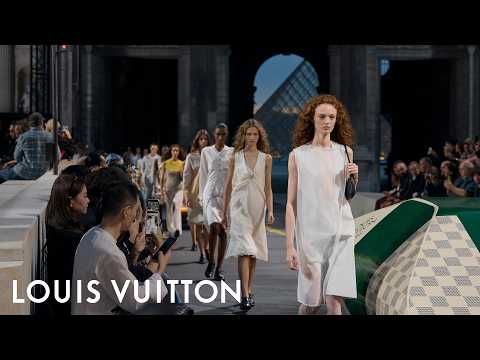
Hermès women's fall-winter 2026 is the collection in the featured film, the house's 15-minute, 53-second “Hermès women's fall-winter 2026 show,” published March 7, 2026, with a one-line description: “Relive the women's fall-winter 2026 show.” The designer was Nadège Vanhée, Hermès's womenswear director, and her subject was twilight.
This film could not be played here. The player failed to load, or the channel may have changed its embed settings.
Video by Hermès · Paris, France, Europe · 15:53 · 2026-03-07. Embedded from YouTube as the featured film for this article. Home, Art & Family does not host the file.
Twilight indoors
The venue was the barracks of the Garde Républicaine, the French unit that protects the president and government. WWD described a maze of a runway twisting through soft moss and green undergrowth beneath a recreated dark-blue sky. AnOther's Alexander Fury marveled that the house had turned the barracks into a moss-massed scene of luminous twilight, indoors, in the middle of the day. “Why? Because they can.”
Twilight was the idea. Vanhée told Vogue she was thinking of the “liminal realm” between day and night: “It's a moment of changes, of movement.” To Fury, three days before the show, she used the French expression entre chien et loup, between dog and wolf: “It's where the familiar becomes unfamiliar, strange.”
The colors of dusk
Vogue traced the palette as a sunset: hot colors shading into deep red, the green flash when the sun dips below the horizon, then dark blue and gray-black. Fury saw petroleum blues, merlot burgundies and a phosphorescent lichen chartreuse on a suede bag that almost glowed in the dark. Her shorthand, he reported, was “Hecate meets Deborah Turbeville,” Greek myth crossed with hazy 1970s romanticism. WWD's brightest note was a short shearling jacket the color of lemon meringue pie.
Revealing and concealing
Vanhée called the collection “resolutely about modernism,” and about “the question of female agency.” The silhouette was narrow and aerodynamic, with pockets and zips adjustable at will. Two leather coats had zippers spiraling around the torso and hips. Winter coats came with removable shearling collars. “You can conceal and be absolutely sexy,” she told Vogue. “It's about revealing and concealing. And it's not a dichotomy. It's definitely a tandem.”
Riders in motion
Hermès was founded in Paris in 1837 by Thierry Hermès, a saddler and harness maker producing equipment for riders and their horses, and jodhpurs replaced tailored trousers here, Vogue noted, nodding to that equestrian heritage. Stretch shorts went under A-line miniskirts so a woman could hit her stride. Fury described a model in brief cycling shorts under a sliced-out jersey jacket with a calfskin collar and a silver châtelaine at the waist, “a little like Lara Croft,” and wrote that Vanhée's women dress like riders but move like horses, built for speed.
Practical poetry
WWD saw clothes for an evening of outdoor exploration: four-pocket military-style leather jackets, salopettes, collars that zipped into hoods, quilted jackets with motorcycle padding, black Cossack hats and flat thigh-high boots. It also noted 1960s A-lines, collegiate leather minis with shirts and ties, and tights in dark green, corn yellow and burgundy. Vanhée said she wanted to fuse “poetry with practicality.”
One print
The collection's only print came from A.M. Cassandre. Vogue described it as adapted from a design by the Art Deco–era poster artist, a cloud-dotted sky beyond an abstract tower, quilted onto a zip-front shirtdress with knit sleeves. AnOther identified it as a carré Cassandre devised in the 1960s showing a scaffolded structure framing a clouded sky, sliced and pieced into brief quilted dresses. “Not as decoration, but to support the body,” Vanhée said.
What comes next
Both Vogue and AnOther noted a larger horizon: Vanhée plans to launch Hermès haute couture the following year, which AnOther calls the house's first ever. The history has a footnote: Wikipedia records that a first women's couture apparel collection was previewed in Paris in 1929, though that predates the formal haute couture line now planned. Fury's broader point was that Vanhée has never rested on the house's voracious demand. She explores and expands its universe season on season, often subtracting from her clothes but adding to her world. Leathers were burnished for iridescence, ribbed knits backed in alternate hues, denim woven in burgundy and citron yellow, everything shifting under light.
The film captures the effect in motion: a moss maze, a manufactured dusk, and women in flat boots moving through it at speed. That pairing of romance and utility, Vogue observed, is rare. Here, it was the whole point, and the house that once made harnesses for horses dressed its riders for the hour when the light goes.
Questions and answers
Who designed Hermès women's fall-winter 2026?
Nadège Vanhée, the house's womenswear director.
Where was the show held?
In the barracks of the Garde Républicaine in Paris, transformed into a mossy twilight landscape.
What inspired the collection?
Twilight, the moment between day and night, which Vanhée called entre chien et loup.
Is Hermès launching haute couture?
Vogue and AnOther reported that Vanhée plans to launch the house's first haute couture line the following year.
Sources
Facts about the topic come from the sources below, checked when this article was written. Details about the film come only from its published title, credit, runtime, date and channel notes.
- vogue.com https://www.vogue.com/fashion-shows/fall-2026-ready-to-wear/hermes
- anothermag.com https://www.anothermag.com/fashion-beauty/17043/hermes-autumn-winter-2026-show-review-nadege-vanhee
- wwd.com https://wwd.com/runway/fall-2026/paris/hermes/review/
- en.wikipedia.org https://en.wikipedia.org/wiki/Herm%C3%A8s
From the channel
Relive the women's fall-winter 2026 show. #HermesFemme *** Welcome to the world of Hermès: In 1837, Thierry Hermès opened his workshop making the finest quality harnesses and saddles in the heart of Paris. Today, Hermès is still a family company whose craftspeople make, often by hand and always with love , bags and belts, diaries and dishes, scarves and shoes, perfumes and purses, ties and travelling furniture, as well as gloves, hats, watches, jewellery and clothes.
This is the description published with the film on YouTube, excerpted here.