Home, Art & Family · Art · Fashion · Gucci Spring Summer 2025: Sabato De Sarno's Sunset at the Triennale
Art · Fashion · Feature
Gucci Spring Summer 2025: Sabato De Sarno's Sunset at the Triennale
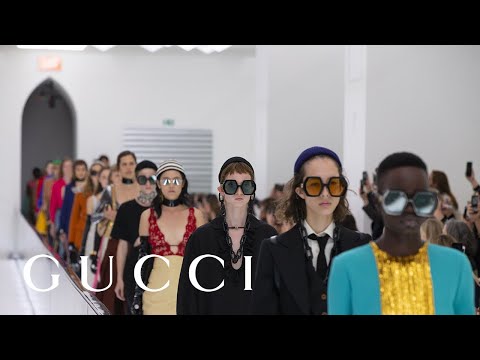
Gucci Spring Summer 2025 is the collection in the featured film, GUCCI's “Gucci Spring Summer 2025 Women's Fashion Show,” a 14-minute, 49-second film published September 20, 2024. Creative Director Sabato De Sarno presented it at Triennale Milano, whose rooms were transformed into hues of a summer sunset. His note: “It's the moment the sun dives into the sea at the end of an August day. It's the moment we find ourselves.”
This film could not be played here. The player failed to load, or the channel may have changed its embed settings.
Video by GUCCI · Milan, Lombardy, Italy, Europe · 14:49 · 2024-09-20. Embedded from YouTube as the featured film for this article. Home, Art & Family does not host the file.
A collection about a moment
De Sarno's statement frames the clothes as a pause. “A precise moment in time. A moment to seize and live to the fullest,” he writes, calling the collection “a tribute to those moments, and an invitation to stop, seek your own moment.” Gucci says each room of the venue took a different tone of sunset, “each the embodiment of an unrepeatable moment.” The house tagged the collection #GucciIstante.
The soundtrack is credited to Mark Ronson and Julian Dobson, with additional production by Tom Elmhirst and Brandon Bost, and includes Kelsey Lu's “Sunset (from HYDROHARMONIA),” Kelsey Lu and Mykky Blanco's “French Lessons,” Boys Noize and Kelsey Lu's “Love & Validation,” Rogê's “Existe Uma Voz,” Jamie xx's “G.I.R.L.” and Fiordaliso's “Non Voglio Mica La Luna.”
The Triennale
The venue is one of Milan's design landmarks. The Triennale di Milano is a museum of art and design in the Parco Sempione, housed in the Palazzo dell'Arte, built between 1931 and 1933 to designs by Giovanni Muzio, who also designed its theatre, the Teatro dell'Arte. The institution began in 1923 as an international exhibition of decorative arts in Monza before moving to Milan in 1933.
The Milan Triennial exhibition was held there thirteen times between 1936 and 1996, and again in 2016, and a permanent museum of Italian design opened in 2007. Turning such rooms into gradients of sunset placed Gucci's clothes inside a temple of Italian design.
Sabato De Sarno
A technician from Naples
Sabato De Sarno, born in 1983, is from Cicciano, a town near Naples. He studied at Milan's Istituto Secoli, seeking technical training in garment construction, and describes himself as a technically focused designer who emphasizes pattern-making. He started at Prada in 2005, then worked for Dolce & Gabbana, and from 2009 spent more than a decade at Valentino, rising to Fashion Director over men's and women's collections.
Two years at the top
Gucci appointed him creative director in January 2023, his first time leading a major house. His debut in September 2023, dubbed Gucci Ancora, Italian for “Gucci again,” introduced Gucci Rosso Ancora, a velvet burgundy with an oxblood hue. The New York Times's Vanessa Friedman called it “a cleansing interregnum after the overblown muchness of Mr. Michele's tenure.” His tenure ended on February 6, 2025, less than five months after this show.
The house in transition
Gucci was founded in 1921 by Guccio Gucci in Florence, selling imported leather luggage from a shop on Via della Vigna Nuova. It became a global brand under his son Aldo, and it launched the Bamboo bag in 1947 and the Jackie Bag in 1961. Tom Ford was named creative director in 1994, and in January 2015 Alessandro Michele began what Wikipedia calls the Renaissance of Gucci.
De Sarno was hired, Wikipedia says, to “reestablish Gucci's edge” and “restore its brand equity” after the Michele era's success had eroded the brand's luxury glow. In 2024 Gucci operated 529 stores and generated €7.65 billion in sales; Demna has been creative director since March 2025. This show is therefore one of De Sarno's last statements for the house.
Codes born of scarcity
Some of Gucci's best-known codes came from shortage. During World War II the company made handbags of cotton canvas rather than leather, distinguished by a double-G symbol and prominent red and green bands. The 1947 Bamboo bag, with lightweight bamboo handles, was a response to continued post-war scarcity, and the brand's first global tagline read: “Quality is remembered long after price is forgotten.” A designer who prized technique and pattern-making was, in that sense, working in a long house tradition of craft solving practical problems.
Watching the film
Nearly 15 minutes long, the film moves through the colored rooms with the light changing tone, a structure that mirrors the idea of a passing moment. Watch for how the sunset palette meets the clothes, and listen to the soundtrack, which is as carefully assembled as the collection.
Questions and answers
Where was the Gucci Spring Summer 2025 show held?
At Triennale Milano, whose rooms were transformed into hues of a summer sunset, according to Gucci.
Who designed Gucci Spring Summer 2025?
Sabato De Sarno, Gucci's creative director from 2023 until February 6, 2025.
What music was used in the Gucci Spring Summer 2025 show?
Music by Mark Ronson and Julian Dobson, with tracks including Kelsey Lu's “Sunset,” Jamie xx's “G.I.R.L.” and Fiordaliso's “Non Voglio Mica La Luna.”
Who is Gucci's creative director now?
Demna, since March 2025, according to Wikipedia.
Sources
Facts about the topic come from the sources below, checked when this article was written. Details about the film come only from its published title, credit, runtime, date and channel notes.
- en.wikipedia.org https://en.wikipedia.org/wiki/Sabato_De_Sarno
- en.wikipedia.org https://en.wikipedia.org/wiki/Gucci
- en.wikipedia.org https://en.wikipedia.org/wiki/Triennale_di_Milano
From the channel
“A precise moment in time. A moment to seize and live to the fullest. It’s the moment the sun dives into the sea at the end of an August day. It’s the moment we find ourselves. This collection is a tribute to those moments, and an invitation to stop, seek your own moment.” — Sabato Creative Director Sabato De Sarno presented his new Spring Summer 2025 womenswear collection at Triennale Milano where its rooms were transformed into hues of a summer sunset, each of a different tone, each the embodiment of an unrepeatable moment. Music by Mark Ronson & Julian Dobson Additional production by Tom Elmhirst and Brandon Bost…
This is the description published with the film on YouTube, excerpted here.